About My Book

Learn more about my first book, Six Pack: Emergence.

Sunday, February 11, 2018

Political Themes: Planet Of The Apes

Planet of the Apes was released in 1968, in a time when movie studios didn't believe that science fiction could appeal to a mass audience. It was also released during a time in which the United States was politically charged in more ways than those who reminisce about "the good old days" may realize.

The movie is a prime example of not only how political themes can be explored in a movie, but doing it with a protagonist who is not likable to start and who some viewers might have trouble sympathizing with at first. And when said political themes are explored, they are done in a way in which it's not always obvious upon first glance.

The first act of the film focuses on the plight of the American astronaut Taylor, who joins three other astronauts on a mission in space, in which their ship is traveling near the speed of light and follows the theory that, while hundreds of years will pass by, the crew will hardly age. In the opening scene, Taylor's attitude at first appears to be that of a man who engages in deep, philosophical thinking. Consider this observation he makes before he enters hibernation:

"You who are reading me are now a different breed -- I hope a better one. I leave the 20th century with no regrets. But one more thing -- if anybody's listening, that is. Nothing scientific. It's purely personal. But seen from out here, everything's different. Time bends. Space is boundless. It squashes a man's ego, I feel lonely.
"That's about it. Tell me, though. Does man, that marvel of the universe, that glorious paradox who sent me to the stars, still make war against his brother? Keep his neighbor's children starving?"

But it's not long before we find out that Taylor didn't make these observations because he is a great philosopher. He's revealed to be arrogant, cynical and often dismissive of his fellow astronauts. He ridicules Dodge for leaving a small American flag in the rocks and his heroic instincts. Taylor mocks Dodge for being the type of person who would sign up for this mission to seek out new adventures for personal glory, while considering himself a seeker of his own type. "I can't help thinking that somewhere in the universe there has to be something better than man. Has to be," he muses.

And after Taylor becomes quite dismissive of the primitive humans that roam this planet, you wouldn't think this is the type of person you'd want to root for. Only the long journey in which it takes days for the astronauts to seek out life keeps the audience from turning on Taylor.

But when Taylor reaches the height of his arrogance, that's when the revelation that the planet is dominated by a race of intelligent apes comes about.

It's at this point that Taylor's path starts to take a turn from viewers merely empathizing with Taylor to sympathizing with him. On this planet, humans are treated as inferior. The dismissive nature of Dr. Zaius makes it clear that he has no time for "domesticating" human beings and that, while he's fine with experimental surgery on a human's brain, he wants nothing to do with studying humans to see if they can gain intelligence. Consider this quote from Zaius:

"Why, man is a nuisance. He eats up his food supply in the forest, then migrates to our green belts and ravages our crops. The sooner he is exterminated, the better. It is a question of simian survival."

Take that quote and change it around to describe any group of human beings, whether born that way or not, and you can see the immediate political implications.

There are more subtle ways of delivering political themes throughout the movie, too. As many who have broken down the film observe, the apes themselves are divided into social classes. The gorillas, who have the darkest complexion, are either soldiers or perform menial tasks. The orangutans, who have the lightest complexion, are the politicians and priests. The chimpanzees, whose complexions fall in between, are the scientists and philosophers.

But there's another way to think about the racial allegory. The orangutans and the gorillas find human beings beneath them and, while a few chimpanzees are sympathetic to the humans, hardly any want to treat the humans as equals. Indeed, the female chimpanzee scientist Zira takes an interest in Taylor and wants to learn more about him and if it is true that another intelligent race -- perhaps of humans -- existed before simian culture. But she still insists on putting a leash and collar on Taylor, making it clear she doesn't see Taylor at first as truly being her equal.
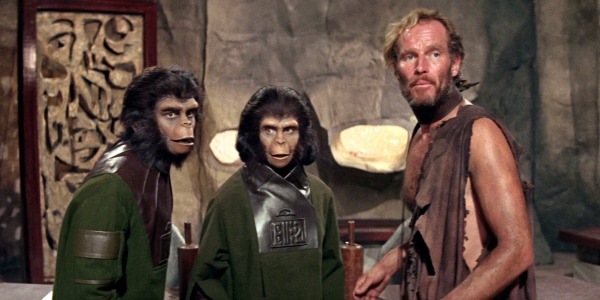
Events lead to a tribunal hearing that resembles the hearings during the rise of Joseph McCarthy in Congress, in which multiple people were continually pressed about whether or not they were members of the Communist Party, simply because these people spoke out against American policies at the time. Indeed, the hearing is revealed not to be a trial to determine whether or not Taylor has committed any sort of crime, but to portray Zira and her husband Cornelius as guilty of heresy for daring to consider that another intelligent race of beings existed before apes.

Not only are the hearing portrayed similar to the McCarthy hearing, they throw in hints of the Scopes trial, in which the theory of evolution was brought into question and how it conflicted with Biblical stories that were used to determine when humans came into existence. In both cases, there's a political theme about how government authority can be subject to abuse.

All the while, though, you don't see Zaius portrayed as a one-dimensional character. In fact, there are hints that Zaius believes Taylor's claim that he came from another planet, but is more willing to accept that Taylor must come from a tribe of mutants elsewhere on this planet. You get a sense that Zaius may know more than he's letting on, but that he must have a reason for not revealing what he really knows.

These events, along with Taylor becoming attached to the mute female Nova, turn Taylor into a more sympathetic character than he was at the beginning of the film. Viewers who weren't inclined to cheer for Taylor at first are now given reasons to do so.

Getting back to Zaius, what he really knows is revealed in the final acts after Cornelius and Zira help Taylor and Nova escape, then explore an archeological dig that suggests that human being possessed intelligence and a more advanced culture at one time. The revelation of a human doll that talks would, at first glance, appear to vindicate Zira and Cornelius about their theories. But Zaius asks Cornelius to read an article from the sacred scrolls, one that puts Zaius' views on mankind into perspective.

"Beware the beast Man, for he is the Devil's pawn. Alone among God's primates, he kills for sport or lust or greed. Yea, he will murder his brother to possess his brother's land. Let him not breed in great numbers, for he will make a desert of his home and yours. Shun him, drive him back into his jungle lair, for he is the harbinger of death."

This article forces Taylor, for a moment, to reconsider that Zaius has a point, because the article sounds a lot like the observations Taylor made when he was on that spaceship. Still, Taylor insists on looking for his own answers and Zaius allows he and Nova to escape, then orders the archaeological dig sealed so that nobody will know the truth -- but as he tells Zira that he is sorry she and Cornelius must stand trial for heresy, he has good reason to keep the truth hidden, as he hints when Zira asks Zaius what Taylor will find out there: "His destiny."

And that, of course, leads to the big reveal that Taylor has been on Earth all this time, and the obvious political allegory about the dangers of nuclear war is thrown right into viewers' laps.

All the while, though, there are more political themes and allegories rolled out -- but what makes them work is that they are done without making it too obvious to the viewer. There are also moments in which humor is injected and a few tropes of adventures films are rolled out.

Most of all, the protagonist isn't always in the right and the antagonist has a valid point. But what keeps the antagonist from being somebody you would sympathize with is not his ideology, but his methods. Meanwhile, the protagonist's ideology isn't necessarily one every person who watches the film will agree with -- and while some may not appreciate the methods the protagonist employs, most would understand given the protagonist's predicament.

And in the end, viewers are left with the question: Was Taylor right about how there has to be something better out there than man -- or was he right to become mankind's chief defender?

Saturday, February 10, 2018

The Arrowverse "Other World" Project

I've had several story ideas floating through my mind and one kept coming back to me -- one that goes back to one of my loves as a comic book geek.

I'm a big fan of what's known as the Arrowverse on CW, referring to the multiple shows that are based on DC Comics characters. Arrow was the first of these shows, followed by The Flash, Legends of Tomorrow and Supergirl, and these shows have crossed over with one another several times. More recently, Black Lightning premiered on CW and, while it is not yet considered part of the Arrowverse, the show creators have left open the possibility of crossovers in the future.

And as I explored more of DC Comics and what is known as "other worlds," I kept getting this story idea in my mind about an alternative version of the main characters in the Arrowverse. I couldn't get this story idea out of mind, but knowing that the characters in question are owned by DC, I couldn't put together a novel for publication for money.

But then I thought -- why not roll out this story on my blog? I generate no money from this blog, so I figure that might be okay to do.

For those who aren't familiar with "other worlds" in DC Comics, it refers to exploring variations of DC Comics characters that don't fit right into the main continuity. Some of the examples and their "what if" situations are:

* Superman, Red Son: What if baby Kal-El's rocket landed in the Soviet Union instead of Kansas and he grew up knowing the values of that nation?
* Batman, Gotham by Gaslight: What if there was a Bruce Wayne who existed back in the later 1800s who became a masked vigilante hunting down Jack the Ripper?
* Justice League: Kingdom Come: What might the Justice League look like when the members are much older and their proteges and children are now the primary heroes?

That brings me back to the "other world" I had in mind for the Arrowverse, in which I thought about different versions of Green Arrow, The Flash, Supergirl and White Canary. In my story, you don't see the versions of the characters as they appear in either the comics or the CW shows -- these are alternate versions of the characters.

My plan is to write a "chapter" at a time, let that chapter sit for a week, then go back to review and revise, before posting it to my blog. Once that's done, I'll post the chapter. Though my plan is to post chapters on Wednesdays, they may go up other days depending on my schedule.

In the meantime, you'll be able to critique and comment on the writing and what you think works or doesn't work for you -- or just sit back and enjoy what I have to share.

I do have other writing projects I hope to complete as my work schedule lightens, but I hope to fit this "other world" in as I have the time.

One heads up: I will be putting up disclaimers that I don't own the rights to the characters and, therefore, the stories will not be published in book form. I don't believe there will be legal issues from sharing a story for free on my blog, but if it there is a problem (and I hope there won't be), I may have to stop sharing these stories. Also, these will be "family friendly" stories in line with the guidelines Clean Reads, the publisher of my Six Pack series, has in place.

I hope you will all enjoy what I have planned in the coming weeks -- and you can still expect my regular blog updates on Sundays.

Read the chapters so far (character listed is whose viewpoint is shared):
Chapter 1 - Supergirl
Chapter 2 - Canary
Chapter 3 - The Flash
Chapter 4 - Green Arrow
Chapter 5 - Supergirl
Chapter 6 - Canary
Chapter 7 - The Flash
Chapter 8 - Green Arrow
Chapter 9 - Canary
Chapter 10 - Supergirl
Chapter 11 - Green Arrow
Chapter 12 - The Flash
Chapter 13 - Coming soon

Sunday, February 4, 2018

Works Are Political, But Not How You Think

Many believe that political polarization is at an all-time high and some believe that it's time for entertainment to stop being so darn political.

Both the critics and the defenders of political themes in books, movies, music and TV shows fail to understand some key points. The critics fail to understand that much of what has passed off for entertainment has been political in nature, but the defenders of entertainment fail to understand how political themes were handled.

For those who think entertainment shouldn't be political, it's been happening longer than you think. In books, you have 1984, Huckleberry Finn and The Hunger Games. In movies, you have Planet of the Apes and a few recent films in the Marvel Cinematic Universe. In music, Creedence Clearwater Revival slipped plenty of political themes into their songs, ditto for John Mellencamp and Bruce Springsteen. Comic books have explored them, too, as evidenced by The Watchmen and the Civil War storyline in Marvel Comics.

But for those who point out that entertainment has been political, one needs to examine how political themes were inserted into the works. Movies used allegories to make a point. Songs were subtle with their political themes, in which you would have to pay close attention to the lyrics to notice them. Books that explored such themes used alternative realities and speculated about the future to illustrate points. Most of all, those who explored political themes in such works, while some were more obvious than others, didn't beat people over the head with them.

Sticking with books, what really makes a political theme work is when you have complexity, where your protagonist may not always be in the right but is kept relatable, where the antagonist has a valid point but his or her methods are questionable, and where you don't provide the reader an easy answer to the problems faced.

Those who do the best job at exploring political themes in their works don't make it easy for people who read or watch the products to determine who is right or wrong -- though they may find themselves sympathizing more with a particular character. And they are the type of works in which you go back and read or view them again, you might find yourself asking if the person you sided with the first time is really the person you should have sided with.

I think the real problem is that those who don't want forms of entertainment becoming political is because they are exposed to politics so much through 24-7 news media and social media, so they want to escape that. Of course, for those people, they are probably better off cutting down 24-7 news media and social media consumption instead of insisting that nobody producing a book, song or movie can ever touch upon a political theme.

And the problem with those who defend political themes in entertainment is they forget that the best way to make a political theme work is to not engage in absolutes, where one side is declared right in every way and the other side is wrong in every way. Instead, it requires making both sides people that one can empathize with, but might not necessarily sympathize with -- and though readers or viewers might sympathize with the protagonist, there can be times in which readers or viewers question whether the protagonist is doing the right thing. For those who think otherwise, they are the types that are more interested in being told what they want to hear, rather than engaging in introspection.

In the coming weeks, I'll touch upon a few works that explored political themes, how the creators pulled them off and why that's the way one should explore such a theme that way -- and why, if you examine them closely, you are forced to ask yourself difficult questions rather than get easy answers.

Sunday, January 28, 2018

From Watchmen to Doomsday Clock

More than 40 years ago, Alan Moore, Dave Gibbons and John Higgins introduced the world to The Watchmen, a team of superheroes that were intended to deconstruct, examine and parody the concept of superheroes.

Late last year, DC Comics rolled out its latest miniseries, Doomsday Clock, involving some of the characters that trio created, but incorporating them into its mainline DC Universe.

Starting with The Watchmen, who would have guessed that the characters Moore and company created would have become such a critical success that Time magazine would recognize the single volume edition as one of its 100 best novels published in the English language since 1923.

I have come to appreciate the introspection that Moore brought to the world of superheroes, asking the larger questions about what role do they really play in a society and how do they really benefit people, if they do at all. His characters are multi-dimensional, their flaws are highlighted for all to see, but they are given qualities that people can identify with and question who really is in the right.

Ozymandias is considered the world's smartest man and seeks to prove how brilliant his ideas are to save the human race. Rorschach is a skeptic of human nature and see no issues with going to great lengths to ensure the guilty are punished. Nite Owl longs for the days when superheroes were accepted in society. Dr. Manhattan questions whether or not life is really worth living. Silk Spectre must answer questions about her upbringing. And The Comedian is cynical yet more than happy to advance whatever cause the federal government backs.

Watchmen works in large part because it's never clear as to who is really right or wrong as events unfold. It utilizes an interesting technique, with a "story within a story" that features a youth in New York City reading the fictional comic "Tales of the Black Freighter." The fictional comic serves as a parallel to the story of Adrian Veidt, aka Ozymandias, and his plans for saving the world from the threat of nuclear war.

The popularity of The Watchmen was a blessing and a curse for Moore, because language was added into Moore's contract with DC that the rights to the characters would revert to him after a period of time. But as The Watchmen increased in popularity, DC continued to release bound volumes of the series, thus claiming the right to the characters as long as the series remained in print.

That has made the decision to utilize several of The Watchmen characters in the limited series Doomsday Clock a controversial move for some of Moore's biggest fans. That series has had three issues released thus far and has been interesting to see how events unfolded. There is already much evidence that Dr. Manhattan has been messing with the timeline in the main DC Universe (it's been alluded to ever since DC launched its Rebirth effort) and it appears Dr. Manhattan and Superman are due for a confrontation. The series has already presented the first meeting between Ozymandias and Lex Luthor and Batman meeting up with the second person to take up the Rorschach mantle.

Whether or not Doomsday Clock can live up to Watchmen remains to be seen, but given the way the plot is unfolding, it appears we may have yet another critical examination of what superheroes are really all about.

Sunday, January 21, 2018

Book Review: Kistishi Island

Kistishi Island follows the tales of Serena Cole, who gets constant advice from two women only she can see. Her family tries to convince her that her friends are imaginary and others think she has a mental health problem, particularly with how she handles herself against bullies at school.

No longer trusting her aunt, Serena goes out to join her mother at an archeological dig, only to learn that the friends that only she can are goddesses who are native to the island. A mystery unfolds around Serena about the island, the goddesses and what her role will be in saving everyone.

Serena is a strong character, somebody who is easy to sympathize with. Author Jordan Elizabeth Mierek does a great job with Serena's portrayal, particularly how much she wants to be with her mother and how she remains convinced her friends are real (and ultimately proves that is indeed the case).

Though it does take a while for the story to get going, the latter chapters in the book are where I found it harder to put the book down. Mierek does a good job building tension in the latter half of the book, by which point I was rooting for Serena to come through on her journey.

There were a few minor characters who seemed superficial to the story, though. Otherwise, this was an enjoyable book with an interesting concept.

Kistishi Island is a recommended read.

Sunday, January 7, 2018

Twenty Questions With Carolyn M. Walker

My guest for Twenty Questions is Carolyn M. Walker, whose debut novel Immortal Descent will be released April 3 by Clean Reads Publishing. The brief blurb about the book: "Twenty-year-old Ethan unknowingly inherits a rare and ancient power, instantly making him a target and a savior all at once."

You can learn more about Carolyn's work at her website or you can follow her on Twitter here.

So let's hear from Carolyn about her upcoming release.

1. How did you get interested in writing?
I have been interested in writing since I can remember, to be honest. Writing has always been like an art to me. From an early age, I began writing short stories. I love creating worlds and characters and then breathing live into them. My mother’s deep love for books became my own, growing up among hundreds of books in the home.

2. What inspired you to come up with this story?
I have long been fascinated with the supernatural. A few years back, during the angels and demons craze, I began research into the story of the fallen angels and their cursed offspring, the Nephilim. I wanted to explore the ‘what if’ when it came to these beings possibly having “children” of their own. From there the Lorns of Immortal Descent were quite literally born!


3. Tell me about the main character, Ethan West, and what inspired you to create him.
Ethan West’s character was inspired by a couple different things. He’s a lot like me in his love for history, art, and being a seeker of answers. Ethan also struggled with anxiety, something I dealt with at his age. His anxiety particularly comes from his dark past and broken family. When he was young, his mother died of cancer and his father was an alcoholic. Not only is he haunted by his past, he faces an uncertain and terrifying future. It was important for me to show how Ethan must face both his past and his future in order to survive the present.

4. What characters, other than Ethan, did you find enjoyable to write as you progressed with the book?
I enjoyed writing all of the characters but I particularly enjoyed writing about the characters of Rue and Tristan. Ruenna Dawe is a strong and complex female character. She is a very old and powerful Lorn with the capability to hear the thoughts of others. Rue forms a special bond with Ethan early on, as his protector. She represents a conflict for Ethan because he was attacked by a Lorn at the start of the story, yet he must entrust his life to one. Tristan Lowell was probably my favorite character to craft. He is the ultimate Machiavellian character as a cold, calculating, and ruthless tyrant. Yet despite his cruel and sadistic nature, Tristan is refined, with impeccable manners and an alluring disposition. As a Lorn with the ability of mind control, he is very manipulative and enjoys exploiting others. I really enjoyed creating a character you can’t help but love to hate, yet hate to love.

5. What are some of the themes you explored in writing the novel?
I explored the theme of loss, heavily throughout the book. So many of my characters have lost something significant, be it loved ones, their innocence, even their lives. For example, one of my characters named Victoria, is one of Tristan’s minions and she has the power of Banishment—the ability to erase another’s memories. Tristan forces her to use her own ability on herself, erasing her own past. Victoria constantly struggles with the fact that Tristan knows who she really is but because he controls her, she is powerless to do anything about it. That loss repeatedly defines the angry character she has become. Another theme I explore is “good vs. evil.” I expand the idea to encompass “order vs. chaos” on a universal level and the idea that both forces exist in every being. I tie this closely with the recurring theme of immortality and the quest for discovering its origin.

6. What things did you learn along the way as you wrote and edited the book?
I have learned that reading makes you a sharper writer. I have also learned that over-editing can be deadly! I continue to read, even as I write. I have found that some of the best inspiration can be found in reading other works of fiction and non-fiction. When it comes to editing your work, I have learned to be careful! As a professional writer and editor, it’s easy to edit something to death, taking away some of the magic it once had! When I edit, I have to remain constantly aware of this!

7. Tell me more about your short story: Swing High, Miami!
It was a short story I wrote when I was in my early twenties, about a weekend vacation down to Miami for my now-husband’s birthday. The entire trip was a whirlwind of disasters, one after another, making it more of a nightmare than a vacation. Looking back, I realized that the trip was such a series of unfortunate events that it was unbelievably comical. When I saw the call to submission for a “Best or Worst Vacation Story,” I knew I had to share this with the rest of the world.

8. What do you find is the right environment for you to write?
When writing, I like to be in a secluded or private place. Sometimes I like to have complete quiet to concentrate. Other times I like to tune in to instrumental music to “get into the zone” for a particular scene.

9. Are there specific programs or tools you find useful to help you with the writing process?
I used to write out all my stories long hand in a spiral notebook. These days, I use Microsoft Word. I often use Notepad for note keeping. While I type up all new works, I still like to use the old-fashioned pen and paper method for new ideas, character bios, and even outlines. I keep notebooks everywhere—by my bed, in the kitchen, at work, in the car…just in case an idea hits me. And they often do! I have a whole filing case of spiral notebooks, filled front to back with just “ideas” for future stories.


10. What have you found to be useful methods for promoting your writing?
I have a long background in digital marketing, so I find a comfort zone there. I do think that word of mouth has been extremely valuable, if not sometimes the most valuable method to promote my work.

11. Tell me more about the home library your mother had and how that inspired your interest in writing and reading.
My mother’s home library was like no other! She had everything, from fiction, to non-fiction, to poetry, to reference, to picture books! A lot of the books she had were rare books, collectors sets, limited editions, banned volumes, and those no longer in print. In our den, she had custom bookshelves made from hand painted pine wood, to house her books. The shelves covered entire walls and ran from the floor to the ceiling. She even got an old-fashioned library ladder chair for reaching the topmost shelves. I was fortunate to grow up among so many great books, which inspired my love for reading and writing.

12. What would you say is your favorite genre or genres to read?
I absolutely love psychological thrillers. I love how nothing is as it seems! I’m also a sucker for a good mystery! History is a wonderful way to blend mystery and suspense, so I love historical tales too.

13. What are some of the famous books or authors you have enjoyed or inspired you?
Richard Matheson and Neil Gaiman are among my favorites. I also love Nora Roberts, Anne Rice, and John Grisham. Classics I adore are by Edgar Allen Poe and CS Lewis.

14. Any aspiring or independent authors whose books you’ve read that you liked and want to mention to others to check out?
My sister Lynn Veevers just published her debut novel “Pinnacle” with Clean Reads as well.

15. What advice would you give to those who want to write a novel before they actually get started?
Keep writing! Starting can be exciting but it’s the keeping on that’s the real challenge. There will probably be a point that you might begin to wonder what you are doing, or if your story will really go anywhere. You might even wonder why you are trying to write a book at all! Whatever the questions, don’t let them lead to doubts that have you pausing. Even if you only write 100 words in a day, don’t doubt and don’t stop. So many great books never get finished because the author doubted themselves and then stopped.

16. What can you tell me about your work for The Southeast Review and what you learned from that experience?
I worked at the Southeast Review as an intern during my junior year at Florida State University. I wanted to learn more about the inner workings of a literary journal, so I served as a contributing writer and editor for a semester. It was a wonderful experience, and I got to meet with and interview some amazing writers, authors, and talented literary connections that helped me to better understand the industry.

17. I see you enjoy traveling – are there certain places you’ve visited that you particularly enjoyed or were an amazing experience?
Years ago, I was a travel agent and I loved booking people on vacations around the world. Learning so much about travel inspired me to do as much of it myself. Though I’m originally from California, I also spent some time in Washington State where I enjoyed some of the most beautiful snow days ever up there! The mountains are simply breathtaking! My family enjoys diving and snorkeling so we have visited every beach in the state, plus many springs. I’ve also visited Mexico and the Cayman Islands, but my biggest goal is to go abroad to Asia and visit Japan! That’s next on my bucket list.

18. Any particular scores and soundtracks you listen to that inspire your writing the most?
Some of my favorite composers and artists are Hans Zimmer, Philip Glass, Nathan Barr, and E.S. Posthumus.

19. What would you say is the biggest difference between living in southern California and living in Florida?
The humidity, hands down! I have been in heat so dry it was like trying to inhale blow dryer air on the highest setting. But the moisture in the air that is humidity that gets me every time!

20. Who would win a battle of superhero skills: Superman, Batman or Wonder Woman?
Wonder Woman, of course! 😉

Wednesday, January 3, 2018

The Last Jedi Review (Spoilers)

As with The Force Awakens, I watched The Last Jedi twice to take it all in and decide whether the movie really worked for me or not and where it ranks among the Star Wars films.

My thoughts about The Last Jedi are beyond the break -- there are spoilers, so don't read past the break if you haven't seen the film yet.